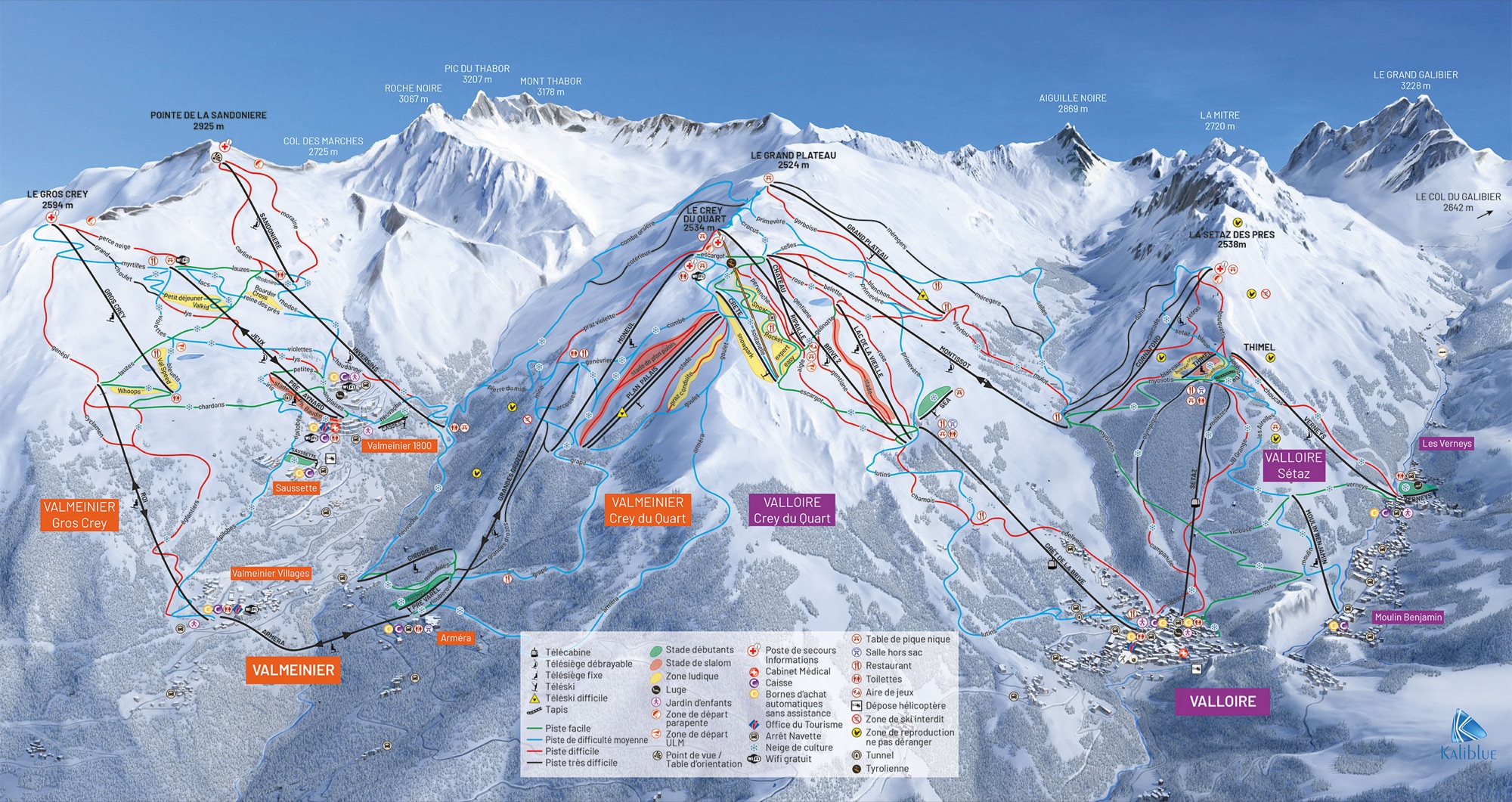
Clicking into your bindings at Valmeinier means opening the door to one of the biggest playgrounds in the Maurienne valley: the Galibier-Thabor ski area. Two valleys, two resorts, one single lift pass and 160 kilometres of pistes connected from one side of the mountain to the other. Whether you are finding your feet on skis for the very first time, lapping red runs from first lift to last, or hunting steep pitches and untracked powder, this linked ski area with Valloire ticks just about every box on the list. In this guide we take you on the full tour of the estate: the headline figures, how the link between the two resorts works, the breakdown of pistes by ability level, the sectors you really should not miss, the snowpark, cross-country skiing, the panoramas from 3,000 metres, snow reliability through the season, and of course every practical detail you need to buy your Galibier-Thabor lift pass and reach the slopes from Chalet Cristal.
One vast ski area shared between two valleys
The Galibier-Thabor ski area takes its name from two emblematic summits that dominate the region and rise above 3,000 metres (roughly 9,850 feet). It brings together under a single banner the resorts of Valloire and Valmeinier, two villages of the upper Maurienne whose slopes meet high on the ridge line to form one continuous, interconnected skiing domain rather than two separate ski hills.
The numbers set the tone for exactly what you come here to find:
- 160 km of pistes, all waymarked, patrolled and machine-groomed, which is enough to ski for several days on the trot without ever repeating the same descent twice;
- around 90 individual runs covering every ability, graded green, blue, red and black;
- close to 30 ski lifts — gondolas (télécabines), chairlifts (télésièges) and drag lifts (téléskis, the button or T-bar lifts you ride standing up on your skis) — with enough uphill capacity to keep queues short even at peak times;
- a vertical drop of more than 1,300 m (over 4,250 feet), one of the area’s genuine trump cards when it comes to stringing together long, uninterrupted descents;
- summits above 3,000 m, which underwrite both the quality of the snow cover and some genuinely breathtaking views.
That scale places Galibier-Thabor firmly in the category of the large Savoie ski areas, but with one significant advantage over its neighbours: it sees noticeably lighter traffic than the giants of the Tarentaise valley just to the north. You ski here with space around you, a relaxed and family-friendly atmosphere, and the very pleasant feeling of never being hemmed in or jostled on the piste. For British and Irish visitors used to the crowds of the big-name mega-resorts, that alone is often the revelation of the week.
The Valmeinier–Valloire link, the heart of the ski area
What really makes this area special is the link between Valmeinier and Valloire. The two resorts sit in separate valleys, separated by a ridge and a series of high cols, and they are joined by a network of lifts that lets you cross from one valley to the other with your skis on your feet — no bus, no transfer, no walking.
In practice, from either Valmeinier 1500 or Valmeinier 1800 you ride up towards the upper sectors, cross the ridge line at altitude, and drop down onto the Valloire side of the mountain, before making the return journey in the opposite direction at the end of the day. That crossing is a large part of the pleasure: it turns an ordinary day’s skiing into a genuine point-to-point journey, where the scenery, the aspect of the slopes and the whole atmosphere change every few descents. Lunch in a different valley from the one you woke up in is a small but memorable luxury.
One piece of advice from anyone who has skied a linked area before: keep half an eye on the clock and on the closing times of the connecting lifts. There is nothing more frustrating than missing the last chairlift home and having to improvise an expensive taxi ride round the mountain. As a general rule, start heading back towards your own side of the hill by the middle of the afternoon, and be especially conservative on busy days or when there is wind at altitude, since the highest lifts are the first to close in poor conditions. The lift company posts the return deadlines at the bottom of each connecting lift — it pays to read them on your first morning.
Pistes for every level
One of the great strengths of the Valmeinier and Valloire pistes is how well balanced they are. The area caters just as happily for the family whose youngest child is clipping into skis for the very first time as it does for the experienced skier chasing adrenaline.
A quick word on grading, because the French system differs from what you may be used to at home. Pistes here are colour-coded green (very gentle, ideal for absolute beginners), blue (easy cruising), red (steeper and more sustained, broadly equivalent to a North American single black diamond) and black (genuinely difficult). North American visitors should note that a French red is considerably more demanding than a US blue, and that green does not exist as a category in the States — it sits below the easiest US green circle. When in doubt, ski one grade below what you would normally choose on your first morning.
Beginners and green pistes
Beginners are particularly well served around Valmeinier 1500 and on the nursery slopes at the foot of both villages, with dedicated learning zones, magic carpets (moving walkways that carry you gently uphill, so there is no lift technique to master) and wide, sunny green pistes. These gentle, easily accessible and carefully secured areas are perfect for building confidence, getting to grips with the snowplough and enjoying those first slides without the slightest stress. The snow gardens and ski schools have an ideal patch of mountain to work with here, and small children can progress from magic carpet to their first real chairlift within a few days rather than a few weeks.
Intermediate skiers: the kingdom of blues and reds
This is without question the ability level that is best catered for. The area is packed with rolling blue pistes that let you cover long distances in complete confidence, and with more committing red pistes for those who want to push themselves without ever feeling out of their depth. Intermediates will particularly enjoy being able to complete the whole Valmeinier–Valloire crossing while staying on runs well within their comfort zone, all the while making the most of that 1,300 m of vertical for long, flowing, uninterrupted descents. It is exactly the sort of terrain on which a competent holiday skier improves noticeably from one week to the next — enough variety to stay interested, never so intimidating that technique falls apart.
Experts: black pistes and off-piste
Experts have certainly not been forgotten. The upper sectors, close to the 3,000-metre summits, serve up demanding black pistes, sustained pitches that hold their angle all the way down, and — depending on conditions and snow cover — some genuinely rewarding off-piste terrain beyond the marked runs. A word of caution, though. In France, anything outside the waymarked pistes is uncontrolled, unpatrolled terrain: skiing it requires proper avalanche safety equipment (transceiver, shovel and probe), ideally the company of a qualified local guide or instructor, and never, ever going out alone. The high-mountain relief of Galibier-Thabor is magnificent, but it demands respect, and a check of the daily avalanche bulletin before you set off is non-negotiable.
Sectors and spots not to miss
Over the course of a day, a handful of sectors are well worth going out of your way for. The upper reaches of the area, close to the ridges, are where you will find the freshest snow and the widest panoramas. They are also the crossover points into the neighbouring valley, so they are unmissable if you want to experience the full spirit of a large linked ski area rather than simply lapping the same lift all week.
On the Valmeinier side, the pistes that drop down towards the base areas of 1500 and 1800 are long, generous boulevards that are a real pleasure to ski as a family — wide enough for parents to keep an eye on the children and for everyone to find their own line. Over on the Valloire side you discover an even more extensive network of runs, with its own distinct character and a good spread of mountain restaurants. Taking the time to stop on a sun-drenched terrace, facing the peaks with a hot chocolate or a glass of something local in hand, is very much part of the experience and not an interruption to it.
To plan your loops for the day, the Valmeinier ski map (the plan des pistes, available as a paper fold-out at the lift ticket office and as a free app on your phone) remains your best ally: identify the connecting lifts, the beginner zones and the high-altitude sectors in advance, so that you can adapt your itinerary to the day’s weather and to the ability of the slowest member of your group.
Snowpark, fun zones and freestyle
Anyone with a taste for more creative riding will find plenty of scope to express themselves. The area offers freestyle features, fun zones and progression areas designed so that you can play safely and build up gradually. Rollers, small kickers, a boardercross course and themed trails allow children and teenagers to discover freestyle gently, while more accomplished riders polish their tricks on the larger features. The modules are sized in stages, so nobody is forced to attempt something well beyond their level in order to keep up with friends.
These fun zones are also an excellent way of breaking up the routine of ordinary descents: it is worth spending half an hour there in the late morning simply to vary the pleasures, before heading back out to explore the rest of the mountain. The controlled setting and the graduated sizing of the features make it a reassuring playground for the whole family, and more than one cautious parent has been talked into their first small jump by an over-enthusiastic ten-year-old.
Cross-country skiing and alternative activities
Galibier-Thabor is about far more than downhill skiing alone. The cross-country skiing areas in both valleys appeal to anyone who prefers a quieter kind of effort and the silence of snow-laden forests. Nordic skiing, in both classic and skating styles, is practised on prepared trails cut through beautifully preserved landscapes, far from the bustle of the lift queues, and the trail passes cost a fraction of a downhill lift ticket.
It is also a fine way of mixing things up for half a day, of giving tired legs a break after several days of alpine skiing, or of keeping non-downhillers in the family happily occupied. Around the cross-country trails you will usually find the other classic winter pleasures too: snowshoeing (an activity that requires no technique at all and is open to absolutely everyone), dog-sledding rides depending on the operators running that season, or simply gentle walks along the groomed winter footpaths. It all adds up to a well-balanced holiday, in which the mountain can be savoured in every one of its forms rather than experienced only at speed.
Panoramas, 3,000-metre summits and snow reliability
What most people remember from a day on Galibier-Thabor is the panoramas. From the high points of the area your eye travels a long way across the surrounding massifs, the sharp-edged ridges and the line of summits topping 3,000 metres — the nearby Col du Galibier, one of the most famous mountain passes in the Alps and a legend of the Tour de France, lies just over the horizon. On a clear day the spectacle is genuinely arresting, and it alone justifies riding up to the top sectors, if only for the view before you point your skis downhill again.
That altitude is also a guarantee of snow quality. Skiing high means benefiting from a better-preserved snowpack — colder, drier and longer-lasting — particularly at the beginning and the end of the season, when lower resorts elsewhere in the Alps can be struggling. Combined with the vertical drop of more than 1,300 m, it makes possible long and varied descents that run all the way from the snowy summits down to the base areas of the villages. The varied aspects of the slopes, spread between the Valmeinier and Valloire sides, also mean you can effectively follow the sun through the day, chasing the softest snow in the morning on the east-facing pitches and moving round to the west-facing ones after lunch.
Lift passes, opening dates and practical information
For the coming season, the ski area is scheduled to be open from 19 December 2026 to 9 April 2027. Those dates frame very nearly four months of skiing, with the best conditions generally found in the depths of winter, in January and February, and long, gloriously sunny days on the upper slopes as spring arrives.
Buying your pass could hardly be simpler. The Galibier-Thabor lift pass gives access to the entire linked ski area, on both the Valmeinier and Valloire sides. Prices, pass types and durations are all listed on the official online ticket office, where you can buy and top up your pass directly, without visiting a ticket window or queueing at the bottom of the slopes first thing in the morning. It is a real time-saver: your reloadable keycard follows you from one season to the next, and you can head straight for the lift gates the moment they open.
One final practical tip: book or reload your lift pass the evening before, from the comfort of the chalet. You will save precious minutes the following morning, at exactly the hour when the area comes to life and the first tracks of the day are worth every early alarm call.
Getting to the slopes from Chalet Cristal
Staying at Chalet Cristal, in the hamlet of la Torrélière at Valmeinier 1500, means enjoying about as straightforward an approach to the ski area as you could wish for. The free shuttle bus serves the whole resort and its stop is a mere 50 metres from the chalet door. Within a few minutes, with no car to move and no parking to worry about, you are standing at the foot of the lifts.
As for equipment, there is no need to haul your own gear across Europe: Jacky Sport, the resort’s established rental shop at Valmeinier 1500, will fit you out with skis, boots and snowboards suited to your ability, along with well-informed advice on choosing the right kit for the day’s conditions. You can even leave your equipment there overnight rather than carrying it back and forth.
Between the shuttle stop just outside, the rental shop at the foot of the slopes and the online ticket office, everything is in place so that your mornings come down to the essentials: clicking into your skis and savouring those first descents. Book your stay at Chalet Cristal now and make la Torrélière your base camp for exploring the 160 km of Galibier-Thabor.
Frequently asked questions
Does the Galibier-Thabor pass cover both resorts?
Yes. The Galibier-Thabor lift pass covers the whole of the linked ski area, on the Valmeinier side and the Valloire side alike. You can cross from one valley to the other with your skis on, using the connecting lifts, at no extra cost and without changing your pass. That is precisely the appeal of this unified 160 km ski area, and it is included as standard rather than sold as an upgrade.
Is the ski area suitable for beginners?
Absolutely. The Valmeinier and Valloire pistes include a great many green and blue runs, particularly around Valmeinier 1500, along with dedicated learning zones, magic carpets and ski schools staffed by English-speaking instructors. Families find a reassuring, progressive environment in which to start, while more accomplished skiers in the same party head off to explore the reds and blacks higher up the mountain. Everyone meets for lunch.
When does the ski area open for the 2026-2027 season?
The area is scheduled to open from 19 December 2026 to 9 April 2027. Those dates make for a long season of skiing, with the deepest snow in the heart of winter and beautifully sunny days on the upper sectors come the spring. Exact opening dates for individual lifts can vary slightly with early-season snow conditions.
How do I get to the slopes from Chalet Cristal?
From Chalet Cristal, in the hamlet of la Torrélière at Valmeinier 1500, the free shuttle bus stop is only 50 metres away. It takes you quickly to the foot of the lifts, and it runs regularly throughout the day so you can come back for lunch if you wish. For equipment, the Jacky Sport rental shop at Valmeinier 1500 will kit you out on the spot. All that is left to do is enjoy skiing in Valmeinier and the great Galibier-Thabor ski area.